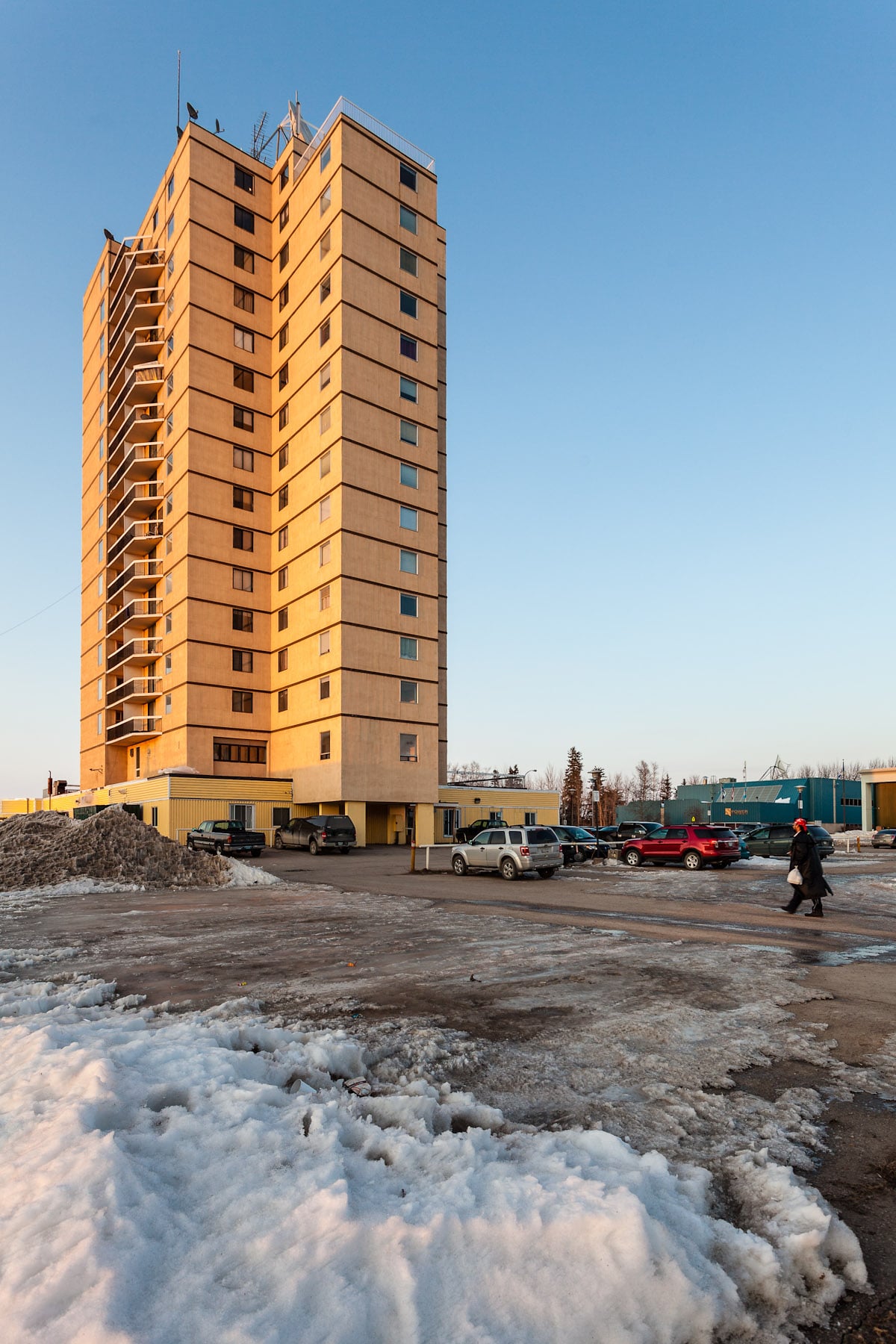
When Art and Anthropology Collide: The Making and Sharing of Mackenzie Place
CASCA Presents

by Lindsay Bell, Associate Professor, Sociocultural Anthropology (University of Toronto)
During my fieldwork on the impacts of diamond mining in sub-arctic Canada, I lived in “Mackenzie Place”, a seventeen-story tower that presides over the center of Hay River (Xátł’odehchee) in the Northwest Territories. Known locally as simply “the High Rise”, the building was for decades home to a diverse set of working-class people from a variety of backgrounds: Indigenous (Dene, Inuvialuit, Cree, Métis), settler, and immigrant. Built in the 1960s on the promise of the proposed Mackenzie Valley pipeline that never came to pass, the building has since been repurposed to house those making a living working in extractive industries and supporting public sectors.

Architecturally, Mackenzie Place looks like many other North American postwar towers built to deal with urbanization. In the context of a small northern community, the High Rise is a visual anomaly. With everything else around only one or two stories high, the building looks like it was left there by accident. I chose to live in the high rise as it was home to those said to be benefiting most from extractive industry, the underemployed, and in migrants from neighbouring Indigenous communities, rural parts of Canada and around the world.
While I had set out to write about the Canadian diamond industry, what I found in the High Rise was that people in this part of the Northwest Territories did not relate to a particular mining project but rather to the long process of colonial extraction. While I had a sense of my argument, I continued to struggle with how to show it in writing. Surprisingly, it was a collaborative exploration in new media with artist Jesse Colin Jackson (UC Irvine) that allowed me to shift my narrative focus from diamonds to the High Rise. What was at first a strategic housing choice became the anchor of the story I wanted to tell. Embodying the logic, loss and hope that extractive industries bring, this worn-out building, and the tenants that came, went, or stayed painted a picture of the larger process of extraction in a liberal-settler state.

When we met in 2012, Jesse had been photographing Canadian post war towers much like the High Rise. While his body of work had concentrated on their place in urban landscapes like Toronto, Mackenzie Place provided a unique example of this ubiquitous architecture. Jesse’s background in architecture and knowledge of the structure of this type of building forced me to reconsider this iteration of a housing type as part of a larger whole. Together we designed a series of visual experiments that allowed us to work alongside one another to see how art and anthropology might come into productive conversation. We describe our methods in a recent special issue of the bilingual journal Civilisations on Anthropology and Photography (Le Meur et Petit 2023, Bell et Jackson 2023).
The visual outcomes of our decade-long collaboration were brought together in Jackson’s exhibition Mackenzie Place, which opened at Pari Nadimi Gallery in Toronto in March of 2023. The focus of the exhibition is a multi-channel time-lapse film shot from the roof of the high rise. The film aggregates the carousel of space and time that the building and its diverse inhabitants bear witness to, year after year. Derived from nearly one million still images captured over five years, the film brings to life a panorama of environments and activities across all four seasons. To the north, we see institutional infrastructure such as schools. To the west, we see industrial areas, with the Great Slave Lake (Tucho) visible on the horizon beyond Canada’s northernmost train line. To the south, commercial and residential fabric are visible, and to the east, we see the namesake river and the seemingly limitless boreal forest beyond, home of the K’atl’odeeche First Nation. As befits its conflicted position in the local imaginary, the building is seemingly erased from the town in the film, remaining present only as a shadow.

One of our shared goals is to “picture the north” as heterogeneous, complex and unfolding rather than reproducing polarizing views of the arctic as a place of extreme fragility or boundless opportunity. When the film was complete, we had to debate the question of how much the images could or should “speak for themselves”? It was one of my graduate assistants, Maddy Herz, who suggested that excerpts of my book Under Pressure: Diamond Mining and Everyday Life in Northern Canada (University of Toronto Press, 2023) might work well as audio recorded and assembled with the moving images. Together with the help of Zsofia Agoston, graduate assistant extraordinaire, I distilled the book into a four-person script—representing High Rise residents—whose voices lend testimony to the experience of place. Jesse’s studio assistant Philip Otto then worked these recordings into the final product.
Without this foray into visual work, I am not convinced I would have been able to finish my book. We are fortunate to be in a discipline that makes room for creative methods and outputs. Most anthropology conferences (including CASCA) have ever-multiplying session types to choose from to allow for different ways of sharing and making knowledge. Multimodal work is no longer fringe. Yet putting this work in conversation with colleagues still presents some obstacles. Traditional conference venues such as convention centres and hotels are ill equipped to create the ideal experience of engaging visual work. Local galleries are usually not feasible options as their exhibition plans are usually made well in advance of a conference’s call for papers. Showing work off site may provide better ambiance, but it can be a challenge to find a venue if you are not local. There is then the extra work of trying to get people to actually go to said venue. There have been many wonderful examples of this, but it demands a lot of foresight, organization and a sufficient budget. This past year we debated showing the work in Tampa at the annual AAA meetings. To rent screens from the venue for the film, we were quoted 13500$- and renting from elsewhere violates the organizations contract with the venue. This reality has prompted us to create a “travel ready” version that consists of four screens and projectors which we can check as baggage and then set up on site. We look forward to the generative engagements it might produce.

You can see Mackenzie Place this May at McGill’s Critical Media Lab as part of the 2025 CASCA conference. Jesse and I are grateful to Julian Flavin and Sam Victor for making this possible.
Support for Mackenzie Place and related scholarly works was provided by SSHRC’s Insight Development program, Western University Social Science, SSHRC Knowledge Mobilization program and the Ontario Research Fund.
MACKENZIE PLACE was showcased at CASCA’s 2025 Conference at McGill’s Critical Media Lab between Wednesday May 7 through Friday May 9th, from 10am -5pm daily.
References
Lindsay Bell et Jesse Colin Jackson, « Parallel play: Experiments in picturing the near Arctic », Civilisations, 72 | 2023, 99-116.
Mikaëla Le Meur et Pierre Petit, « Anthropology & Photography: Introduction », Civilisations, 72 | 2023, 5-26.