Hiipii Project ᐦᐄᐲ: co-creation of a short film in Chisaisbi
Cultureblog
By Roxane Campeau and Antoine Amnotte-Dupuis, University of Montreal
Autumn 2016
Over the course of field stays in Eeyou Istchee with the Chisasibi First Nation, the northernmost Cree community on the shores of James Bay (Quebec), an anthropological short film project gradually took shape. Valuing both the knowledge and wisdom of elders, the ethnomusicological research on the nikimun – spontaneous vocal practice – as well as the skills of the staff of the Chisasibi Heritage and Cultural Center – the local cultural institutional milieu, this project slowly acquired a collaborative dimension respectful of the constraints linked to the oral tradition. The cinematographic work carried out by the filmmaker in collaboration with the partners listed above made it possible to create an original filmic object. Entitled Hiipii, the eeyoush term for the traditional fishing net, the project proves to be a form of representation of a song about maasimaakus – the brook trout. This designation – Hiipii – later turned out to allude to the anthropological concept of meshwork (meshwork) as well as to the particular articulation of the editing, bringing together the perspectives of the people who worked on the project.

Snowmobile journey along the seasonal migratory route leading to the river. Photo credits: Sarah J. Ruper and Antoine Amnotte-Dupuis.
More precisely, the team that led this project includes stakeholders from different backgrounds: an ethnomusicologist, a filmmaker, the director of the Chisasibi Heritage and Cultural Center, an employee of that same institution, as well as descendants of the creator of the nikimun selected. The partners' shared desire to make possible the transmission of the eeyoush way of life linked to land use, through the representation of a song, manifested itself, among other things, in the choices made at each stage of the Hiipii, from development through editing. At the same time, everyone was able to make free choices within their own activity area. For example, the filmmaker filmed freely on the sites, which were freely determined by the family group to situate the vocal practice within the cycle of ancestral seasonal migratory trajectories.
It is essential to the understanding of the approach inherent in the Hiipii project to mention that every nikimun is situated in the genealogical history and in eeyoush territory. In the case that concerns us, the song maasimaakus was created in relation to an important place in the seasonal migratory trajectories of many families from Chisasibi. Furthermore, the time of year when brook trout fishing practice at that specific spot on the river became crucial corresponds to late winter/early spring, a period that can be interpreted as the end of a cycle; the arrival of Canada geese in spring, a substantial source of eeyoush food, can be considered the beginning of a new cycle. Thus the place associated with the practice of the nikimun reveals its importance to us while partly illustrating why this nikimun is known to many people in Chisasibi.
It is interesting to point out that the Hiipii was born from a conversation between the ethnomusicologist and the staff of the Chisasibi Heritage and Cultural Center during which it was noted that in local museal practices, elders' songs are only used as the soundtrack for the various exhibits. The proposal that a single song can 'encapsulate' the eeyoush way of life was the trigger for the collaborative creative process that led to the making of the film. Thus, the 'museological imagination' (Dubuc and Turgeon 2004:14) of the staff of the Chisasibi Heritage and Cultural Center found itself mixed with a contemporary ethnographic cinematographic practice as well as an ethnomusicological perspective, all contributing together to the transmission of the vocal practice itself, but also everything it implies, while striving to respect the modalities of the oral tradition as much as possible.
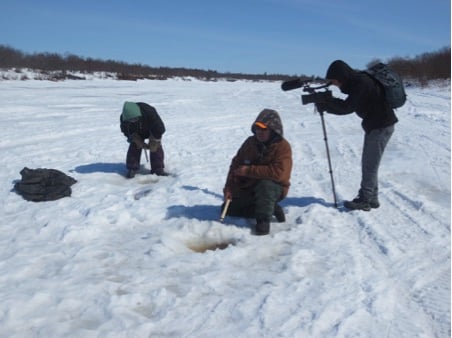
Before filming, a preparatory meeting made it possible to determine the locations, schedule, and people present in the film with the holders of the oral tradition and the staff of the local cultural institute. From a cinematographic point of view, the Hiipii moved away from the participant-observer stance typical of ethnographic film to submit more to the relationship to the other and to the observed's territory, notably by actively taking part in the filmed activity, namely a day of ice fishing preceded by active exploration of the seasonal migratory routes leading to the fishing site. In this case the filmmaker films in order to observe rather than observes in order to film; he films "what he perceives, what he shares of the event as a socially involved observer" (Lallier 2009:54). From the perspective of visual ethnography, one moves away somewhat from the exercise of reflexivity to adopt a posture of multidisciplinary anthropo-socio-psychological mediation because the project involves in its very design individuals, institutions and the family group (Baena et al. 2004:132). In Hiipii, the ethnomusicologist is one interlocutor among others, absent from the camera's frame, to whom the ecological traditional knowledge that supports the situated vocal practice is presented.

Transmission of knowledge about subsistence food in autumn. Photo credits: Sarah J. Ruper and Antoine Amnotte-Dupuis.
In summary, this experience of the Hiipii proved to be an opportunity to collaborate in a spirit where each person attempts to respect the contributions and needs of others, with the common goal of getting as close as possible to the oral tradition and to the constraints and possibilities of an object that has among its purposes integration into an Indigenous museum institution. Moreover, situated within a process of recognition, the Hiipii concretely demonstrates how ethnomusicological and cinematographic work can accompany a process of self-determination that takes place, among other places, in Indigenous cultural institutions in Canada.
REFERENCES
Camas Baena, V., Pérez, A. M., Sotelo, R. M., & Mateos, M. O., 2004, "Revealing the Hidden: Making Anthropological Documentaries".Working images: Visual research and representation in ethnography, 120-134.
Dubuc, É., & Turgeon, L., 2004, "Museums and First Nations: the trace of the past, the imprint of the future".Anthropologie et Sociétés, 28 (2), 7-18.
Christian Lallier, 2009, For a filmed anthropology of social interactions, Archives contemporaines, 250 pp., EAN: 9782914610773.