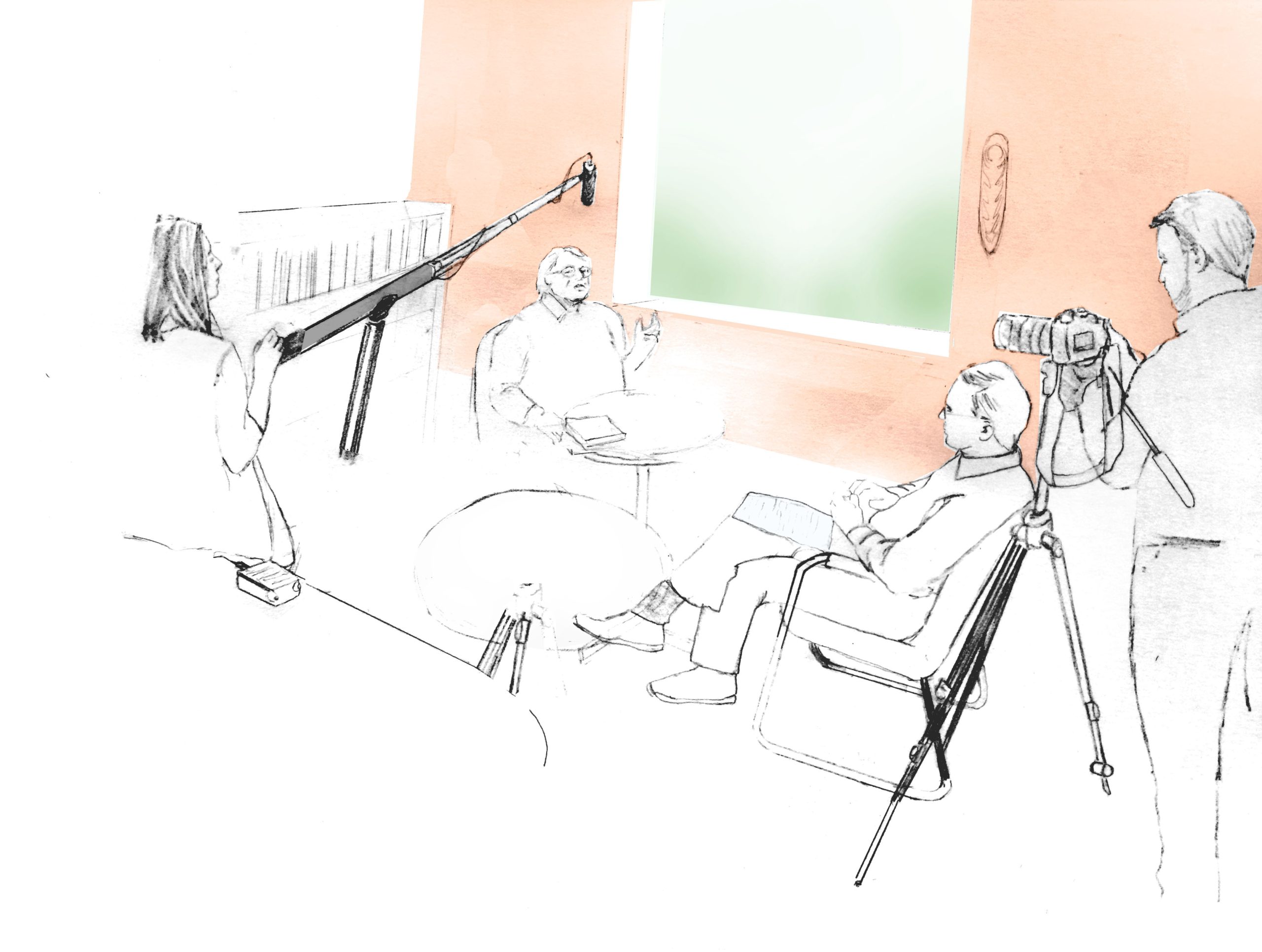
The Possessed and Their Worlds: an ongoing project of visual (auto)biographies
Cultureblog
By Frédéric Laugrand, Emmanuel Luce, and Anthony Melanson, Laval University
Autumn 2016
Launched in 2014, the seriesThe Possessed and Their Worlds is an ongoing visual anthropology project focused on the preservation, enhancement, and dissemination of Canadian socio-anthropology. The series favors the (auto)biographical approach and is interested in the memory of professor-researchers in Canada who have published in the journalAnthropology and Societies and in the journalAnthropologica. Keen observers of societies, the participants stage themselves and tell their stories, offering rich and fascinating materials for the history of ideas, revealing in detail their intellectual trajectories. As Alan Macfarlane writes, who has so far assembled the largest collection of anthropologists' memoirs (more than 225 films), «Once one thinks about the idea, it may seem strange that anthropologists have devoted so much energy to investigating other people’s tribes (including filming them), and so little time on their own. When the ‘ancestors’ are encouraged to talk, they do so with a frankness and insight which it is a pleasure to be involved in preserving. (Alan Marcfarlane, 2004)
From the start, the project benefited from the advice of the Editorial Committee of the journalAnthropology and Societies, interested in the journal developing an audiovisual and digital component as part of its mission to enliven the scientific field of the social sciences and Francophone anthropology. The project also benefited from in-kind and financial assistance from the journal, the Faculty of Social Sciences and the Department of Anthropology at Laval University, as well as support from the journalAnthropologica via that of CASCA and, very recently, a SSHRC grant submitted by F. Laugrand and J. Habib.
Since the beginnings of this undertaking, six objectives have guided the project: 1) to take part in preserving memory by collecting narrations from researchers in anthropology and other related disciplines who have contributed to the journalsAnthropology and Societies andAnthropologica; 2) to promote the transmission of knowledge through audiovisual tools, noting that younger student generations read less but view more images; 3) to stimulate the interest of these younger and older generations by producing film sequences freely accessible, hoping that these groups will return to consult the narrators' written productions which offer complementary and contextual data; 4) to accelerate and intensify the dissemination of anthropology by producing sequences likely to reach the general public and an academic audience, these materials being able to feed teaching in class or at a distance; 5) to enhance anthropology as a discipline and increase its visibility by having anthropologists speak about their vocations, their "anthropological fields", and their methodological and theoretical contributions to the social sciences; 6) to reconstruct the academic landscape of an era as well as an intellectual history with the actors who are, for the most part, the pioneers of the discipline in Canada.
From the outset the team favored testimony and listening, in order to give the narrator the freedom to choose the exact format and content of their account. Thus, while the interviewer provides a framework and a questionnaire, the interviewee uses and adapts it as they wish. The aim is indeed to bring forth speech and to avoid, for the interviewer, the stance of prosecutor or journalist.
All sequences are posted free of charge on the journal's website (https://www.anthropologie-societes.ant.ulaval.ca/) Anthropology and Societies at a rate of two films per week since November 2015. Each film is also offered free of charge on the journal's YouTube channel (https://www.youtube.com/channel/UCb5YUvJjEpeGBvmFOUasKoA/feed) of the journal and announced the same day it is posted on its Facebook page (https://www.facebook.com/anthropologieetsocietes) and its Twitter account (https://twitter.com/Anthropo_et_soc). A new website in the name of the two Canadian anthropology journals is under construction.
The team has, so far, made films with nearly thirty-five anthropologists, sociologists, historians and geographers, amounting to nearly 150 hours of film, accessible in a multitude of sequences, each 25 to 45 minutes long. In autumn 2016, the team will devote itself to meeting about twenty anglophone anthropologists in the Vancouver and Toronto regions, appointments having been made with J. Cruikshank, J. Barker, K. Burridge, S. Rowley, R. Ridington, M. Rodman, D. Young, C. Hickey and M. Asch (September 2016), others with D. Turner, G. Smith, H. and A. Lyons, H. Feit, J. Freedman, M.F. Guédon, R. Lee, D. Preston, R. Darnell and D. Jorgensen (November 2016), not to forget several other colleagues from Eastern Canada (C. Jourdan, M. Elbaz, M. Lock, R. Massé, F. Saillant, S. Bouchard, J.G. Goulet) and others we have yet to contact.
List of films made (2014-2016): With: A. Balikci, P. Beaucage, B. Bernier, G. Bibeau, B. J. Koss, J.J. Chalifoux, B. Chapais, P. Charest, C. Collard, E. Corin, H. Dagenais, D. Delâge, L.J. Dorais, M. Fournier, P. Fougeyrollas, A. Fortin, S. Genest, M.F. Labrecque, D. Legros, R. Lemieux, J. Lévy, F.R. Ouellette, P. Maranda, T. Morantz, J.C. Muller, J.J. Nattiez, M. Pandolfi, L. Paradis, J. Rousseau, É. Schwimmer, J.J. Simard, A. Tanner, É. Waddell.
In sum, the Possessed project remains obviously partial and biased, fragmentary. A few hours of film are not enough to restitute fully lived lives. Pierre Bourdieu also noted the ambiguity of the biographical or autobiographical narrative which seeks "to give meaning, to account for, to bring out a logic that is both retrospective and prospective, a coherence and a constancy" (Bourdieu 1986). But the sociologist underestimates the fact that by juxtaposing testimonies and relating them to one another, they illuminate each other collectively in a new light. It is obviously not only the personal trajectory of a "possessed" person that is enlightening, but the accumulation of testimonies that relate to the same era and the same place, Quebec and Canada. If the life narrative therefore indeed contains an element of fiction and artificial reconstruction, we believe, as Paul Ricoeur once showed (1983), that it still offers a reliable reproduction of action and that it therefore remains one of the best devices for researchers in the social sciences.
Reversing roles and, to paraphrase George Stocking (1984), transforming the usual observer into the observed proves to be a fascinating and rich undertaking, in that it makes it possible to bring to light a multitude of details that would otherwise sink into complete oblivion, often having not been recorded in scientific articles or books.
The collected narrations reveal very different personalities and identities, and a wide variety of knowledge and know-how. One common point, however, emerges: the passion for fieldwork and research. The use of the notion of "possessed" aptly expresses this commitment, these exciting and passionate lives that anthropologists live across the five continents. The "Possessed" are thus possessed in more than one sense: by the fields they carried out, by the objects they studied and which still inhabit them, but also by the experiences they relate with great enthusiasm, thus transmitting to those who listen to them a taste for others.
References
BOURDIEU, Pierre. 1986. "The Biographical Illusion."Acts of Research in Social Sciences, vol. 62-63, June: 69-72.
HIRAUX, Françoise. 2004. "The autobiographical question in university archives. Examination of some practices at the University of Louvain." Manuscript.
RICOEUR, Paul. 1983.Time and Narrative. Volume 1 and 2. The Plot and the Historical Narrative.Paris: Le Seuil.
STOCKING, George W. 1984.Observers Observed : Eassays on Ethnographic Fieldwork. University of Wisconsin Press.
Illustration: The team at work (Drawing: Sophie Privé)