Making and Unmaking Vulnerability in the Time of Disasters
Cultureblog
By Emmanuelle Bouchard-Bastien, Laval University
It’s spring, and soon Quebec’s rivers will spill out into the floodplains, swollen by snowmelt. For some social actors, including the government of Quebec and planning experts, this phenomenon is considered a catastrophe, and floodplains are seen as “at-risk” living environments. Holders of authority over flood management, these experts wish for flood-prone territories to become uninhabited in the near future, in order to protect this so-called “vulnerable” population. Yet, in some of these areas, a cohabitation with the river and its overflows has persisted for generations. Local knowledge and practices regarding preparation and protection against floods have been refined and passed on, enabling riverside residents to live well with rising waters and not regard themselves as “vulnerable” as public authorities now do.
For example, in my research I met riverside residents of Saint-Raymond, where floods occur on average every two years over the last century (Lagadec, 2017), which has not prevented the municipality’s development over the years. Equipped with pumps and generators, and supported by citizen mobilization and a telephone alert system, these residents hold expertise that could inspire other affected places in the province and government protection programs. I also met riverside residents of Saint-Casimir, a flagship village of the industrial era in the Portneuf region and the birthplace of renowned church builders (Tessier, 2012), who benefit from remarkable architecture typically adapted to flooding, composed of buildings with double crawl spaces. I also met inhabitants of the Îles, in Sainte-Anne-de-la-Pérade, who have learned to live with the “seas of May” and the large spring tides, favoring, among other things, construction on stilts.

My doctoral work, which examines the experience of recurrent flooding in the Sainte-Anne River watershed (Quebec, Canada), leads me to value this knowledge and these practices that allow some groups to be adapted to rising waters. Above all, these testimonies allow us to critically question current governance practices, which do not take this citizen expertise into account despite its bringing about a considerable reduction of the vulnerability so feared by authorities.
The meetings I held with riverside residents along the Sainte-Anne River, its tributaries and down to its mouth in the St. Lawrence River, allow me to present to date a plural definition of flooding, and therefore, of vulnerability. In the field of applied sciences, floods are commonly described as disasters characterized by water overflows that temporarily submerge an area that is normally dry (CEHQ, 2020). Among the riverside residents I met, floods can be described in several other ways, depending on lived experiences, historical and ancestral knowledge, understanding of the river or the estuary, protection measures used and family rituals.
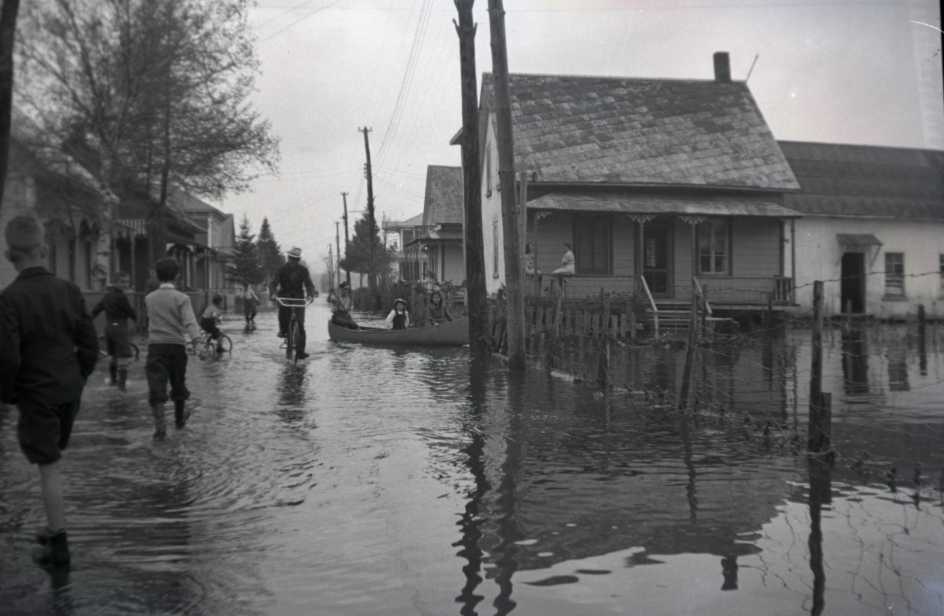
Thus, riverside residents of the Sainte-Anne River watershed do not consider themselves to live in an “at-risk” zone, and do not consider floods to be catastrophes. Collected testimonies explicitly attest to the non-catastrophic nature of the event, that is to say that it does not disrupt daily life: “life goes on”; “it’s normal”; “it’s part of our lives”. The rise in water is accepted. For these residents, it is the price to pay for living by the water. For others, flooding is even synonymous with pleasure, as it is associated with family and friendly gatherings.
Despite the existence of riverside residents adapted to rising waters, the dominant discourse of the authorities responsible for flood management in Quebec tends to promote a homogenization of the concept of vulnerability, and this conceptual construction suggests that all citizens living in flood-prone areas are victims (Marino and Faas, 2020). Certainly, some residents do not have the physical, social and material capacities to cope with rising waters, and the occurrence of a flood can become a traumatic experience. But a good number of riverside residents know and understand their territory, and the dynamics of rising waters are part of that.

In response to the major floods that affected southern Quebec in 2017 and 2019, the government of François Legault instituted by decree a special intervention zone (ZIS), which aims to prevent new construction in flood zones in 783 Quebec municipalities (MAMH, 2019). For riverside residents adapted to rising waters, this institutional takeover is interpreted as a significant loss of power and freedom to act at home. It would be desirable for government intervention to be more rooted locally, rather than undoing the adaptive capacities that are already mobilized in the territory.
Featured image caption: Flood in Saint-Raymond, May 27, 1943 (Source: Fonds J.-B. Martel – E292-B1-662)
Bibliography
CEHQ (2020), Flood zones — General information. Water expertise and dams. Ministry of the Environment and the Fight against Climate Change. Online:https://www.cehq.gouv.qc.ca/zones-inond/index.htm (Accessed March 26, 2020).
Lagadec, A. (2017). Overview of the issue. Flooding of the Sainte-Anne River in Saint-Raymond. Watershed organization: Rivières Sainte-Anne, Portneuf and La Chevrotière sector (CAPSA), 52 pages.
MAMH (2019), Spring floods 2019 — Special intervention zone. Ministry of Municipal Affairs and Housing. Online:https://www.mamh.gouv.qc.ca/index.php?id=6937 (Accessed March 26, 2020).
Marino E. K. and A. J. Faas (2020), Is Vulnerability an Outdated Concept? After Subjects and Spaces,Annals of Anthropological Practice, DOI: 10.1111/napa.12132.
Tessier, G-R (2012), Civil history of Saint-Casimir of Portneuf, Saint-Casmir Historical and Genealogical Society, 318 pages.