The price of the body
Cultureblog
By Tiago Lemões and Cláudia Turra-Magni, Federal University of Pelotas – PPGAnt-UFPel
Notes on food classifications among the “people in street situations”[1] in Brazil
In this text we will present some reflections on the meanings of food and conviviality among men in street situations in Pelotas, a medium-sized city located in the far south of Brazil.
We wish here to analyze two symbolic dimensions of food: food classifications, making explicit a specific conception of “food”, and bodily meanings also revealing a particular notion of the “strong” and well-fed body, as opposed to the body affected by nutritional deficiencies or the ingestion of other substances.
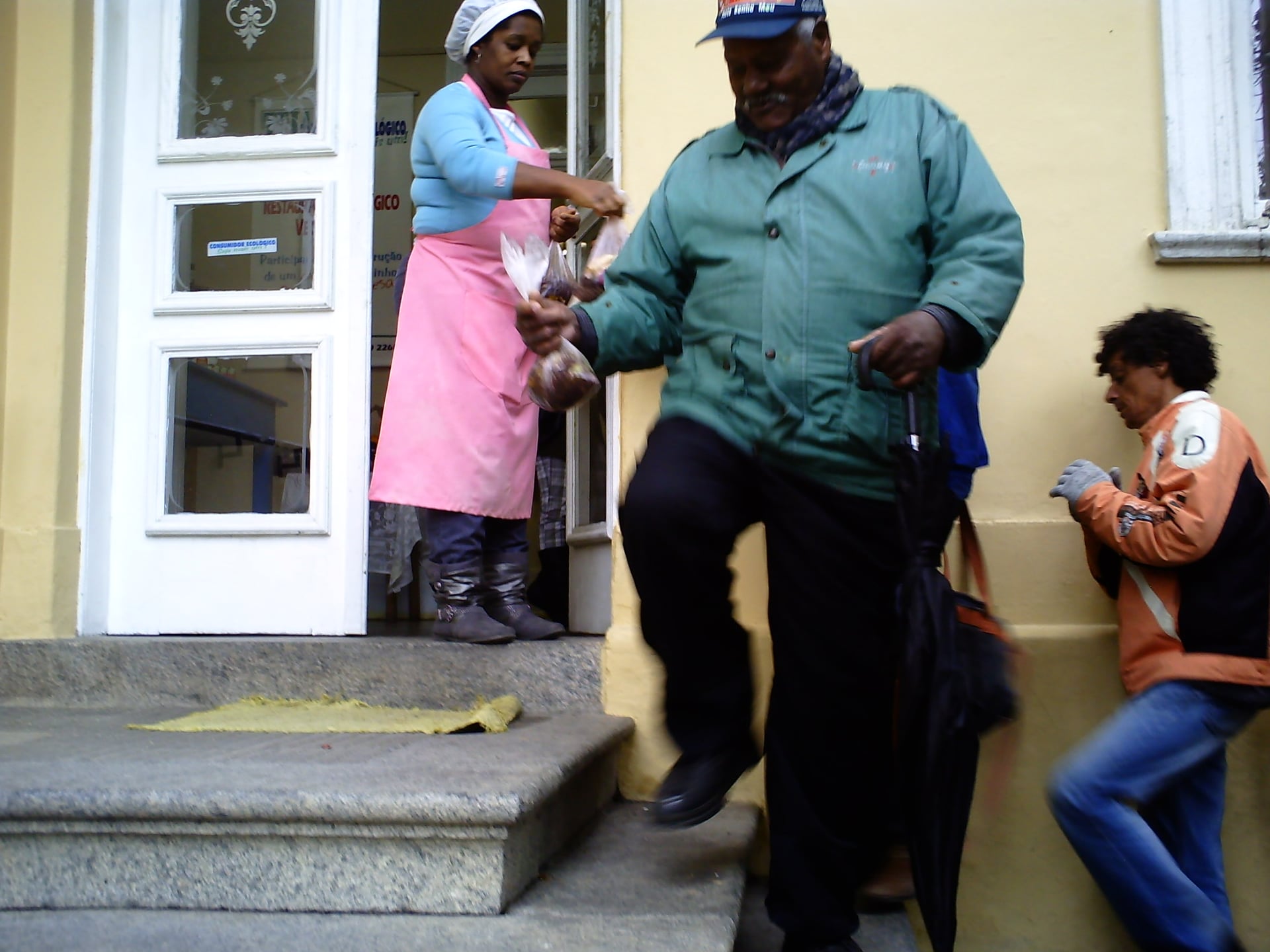
What interests us is to problematize here the way in which these subjects classify the food obtained in the context of street life, marked by experiences of both stigmatization, violence and discrimination, and of aid and reciprocity relationships (MAGNI, 2006). What are the possible relationships between values, moralities and the meanings attributed to food? How do these classifications and interactions around feeding raise questions related to corporeality, health and work? To problematize these questions, we will focus on the ethnographic data obtained during the research carried out between 2008 and 2010, conducted from interactions in two interconnected urban contexts: the street context proper and the food donation situations set up by a vegetarian restaurant located downtown. In this specific context, we would like to study how the relationship of otherness established with a “different food” makes explicit the different food classifications.
Food products given by the vegetarian restaurant and received daily in plastic bags are first perceived as “different food, because not fatty, nor seasoned”, and “not making you gain weight”. They are therefore intended for “people who have problems”. By resigning himself to this food the interlocutor expresses how much meat is appreciated: “if it's given, the guy will complain, he'll ask for meat and yet there are still those who complain… It's just that there is no meat, but it's good.” (Marcos, 29 years old).
Furthermore, according to regional food culture a “good meal” always includes meat, rice, beans, pasta. According to Mr. Edson “a good diet includes pork or lamb, a steak with onions, well-cooked pasta… It's been five years since I ate any.” These dishes take these subjects back to the family environment: a good meal is a meal that a mother prepares at home, because “there is nothing better than the carreteiro (rice with meat) or the beans with bacon made by my mother” (Robson). Young Eduardo, in confessing his nostalgia for his mother, makes the association between this dish and her, described as simple, strong and hardworking.
By understanding that a good meal is a “home-cooked” meal and eaten with family, these interlocutors agree with the meanings of feeding among low-income families. Romanelli (2006) considers that, in these groups, foods are classified into two categories: the substantial ones such as rice, dried beans and meat, and those that serve to “fool the stomach”, such as salads, vegetables and fruits. Red meat, like rice and dried beans, has a certain prestige and therefore, if it comes to be lacking, it is a sign of degrading deficiency, indicative of precarious living conditions (ZALUAR, 1994).
However, this “strong body” also refers to a bodily aesthetic. One expression of our interlocutors is revealing: an individual who has gained weight is described as someone who “has won a prize”. This prize of fatness or bodily robustness does not follow dominant body aesthetic canons. Thus, among the substances present on the streets, food and the crack deserve particular analytical attention, because they highlight an ambiguous and relational association: a thin, weak and puny body (because of the crack) stands in contrast to the body valued for its fatness (LEMÕES, 2013).
Young Robson states that he got off drugs because he regained strength by eating at home, where his mother prepares milk and yogurts. Cláudio, for his part, proudly says he did not exchange food for drugs. He tells how the crack makes one lose a lot of weight, and when he goes under 52 kg, he stops taking it and eats again. Miguel says that “sometimes the galette suppresses the appetite, but when the effect ends, the hunger returns twice as strong”. Finally, Carlos Augusto confesses having stopped the crack because he “was visibly losing weight, almost suffering from malnutrition”.
The fear of losing weight, because of the crack, is not simply linked to the isolated effects of the drug. We are here speaking of a conception of the body that values robustness, a condition necessary to cope with daily hardships, but that also mobilizes the will to control drug intake as a form of domination over the body — wills declared insofar as one knows that bodily degradation implies a “loss of dignity” (RUI, 2014). “Winning a prize” thus influences the relations established with distinct social groups with which these subjects interact in urban space.
In conclusion, the positive image of the robust body, the “prize” acquired by robustness, expresses the valorization of the strong body, fit to face the harshness of the street. The negative image of thinness reveals that a thin body is perceived as weakened, ill and assaulted by the consumption of crack. The advantage of “winning a prize” also manifests itself in power relations established with different groups, for whom a well-fed and strong body signifies distance from drugs. These symbolic and strategic specificities of the body reveal a classification of people: those who stay on the right path and those who stray from it. The body, like food classifications, speaks to us of classifications of people and the social groups to which they belong, making it possible for food and its dietary categorizations to serve as a key to interpreting the different meanings presented above.
References:
LEMÕES, T. 2013. A família, a rua e os afetos: uma etnografia da construção de vínculos entre homens mulheres em situação de rua. Saarbrücken: Novas Edições Acadêmicas.
ROMANNELI, G. 2006. «O significado da alimentação na família: uma visão antropológica».Medicina, v.39, n.3.
RUI, T. 2014. Nas tramas do crack. Etnografia da abjeção. São Paulo: Terceiro Nome.
TURRA-MAGNI, C. 2006. Nomadismo urbano: uma etnografia sobre nomadismo urbano em Porto Alegre. Santa Cruz do Sul: Edunisc.
ZALUAR, A. 1994. A Máquina e a Revolta: as organizações populares e o significado da pobreza. São Paulo: Brasiliense.
Photo: The food distribution set up by the vegetarian restaurant. Photo by Tiago Lemões
[1]“People in street situations” – an approximation of the homeless – is a category commonly used in Brazil, formalized by a Federal Decree of 2009, which establishes the National Policy for the Population in Street Situations.