Mayas, Aztecs, and Aruacos. Three Peoples, One Shared Space
Cultureblog
Roberto Ordúñez Fernández, Baracoa Archaeology Cabinet
With this research we set out to examine the ancient peoples of the Americas and the Caribbean among whom ties already existed long before the conquest, which made clear the great movement between them. We show that there was not only contact between the Maya, Aztecs and Arawaks, but that these peoples of our America were communities with a strong interrelationship.
The Maya have been considered by many specialists as one of the greatest cultures of all the Americas, a cultural group that made a tremendous impact but was able to carry its customs beyond its borders. For many researchers it has always been very difficult and remote to conceive of possible contact between this great empire and the other communities of Central America and the Caribbean.
These, in the Pre-Classic period, did not differ from the other cultural groups of Mesoamerica, where the great Olmec civilization had already been established. The Maya continued the Jaguar custom, a tradition created by the Olmec culture. They were also creators of maize cultivation and of trade, and many of their customs were transmitted to other peoples toward whom they moved (in what are now Guatemala and Honduras), where they carried out the development of a brutal militarism motivated by a combative spirit of conquest. In this same period, as a result of contradictions between the lower classes and the ruling class, the great Maya Collapse originated, a situation that nearly endured until the arrival of the European Conquistadors.
Linguistics as an element to understand Maya contact with the peoples of the Caribbean
When analyzing this situation in our earlier communities in the Caribbean and their relationship with the Maya language, one must assess its influence on many detected aspects. We have seen how the transcultural has its logical basis in the linguistic, and one should also consider that when transcultural characteristics occasionally appear it is because a linguistic exchange between the Arawak and the Maya is present. In this sense, let us analyze why Maya words are present in the vocabulary of our agricultural and pottery-making groups of present-day Cuba and the Caribbean.
Applied Archaeology as proof to understand a reality
We have archaeological data that assure us that already before the conquest the Maya had ventured into these regions of the Caribbean thanks to the geographic situations existing at that time, which allowed them to use the entire area that today comprises Yucatán, Guatemala, Nicaragua, Honduras, Cuba and the Bahamas as a single space. Many of the pieces recently located at archaeological sites in the region, some of which are under the sea, provide reliable evidence of this reality.

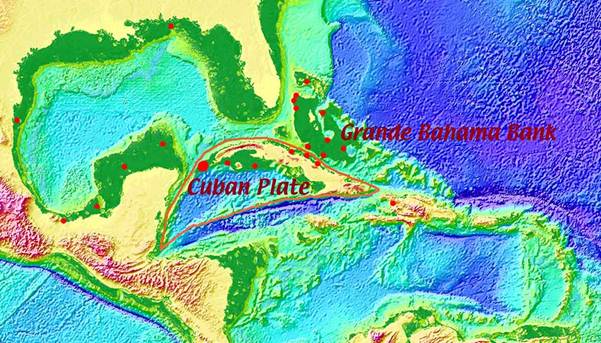
(Discoveries around the Bahamas Bank)
The green area is presently underwater but most of it would have been exposed 8,000–12,000 years ago when sea levels were much lower.
The Grand Bahama Bank would have been a large island up until about 6,000 years ago.
Areas that are possibly old city sites 8,000 years ago are marked here.
The large red spot marks the approximate position of a city recently found in approximately 700m deep water, suggesting a subsidence of the whole Cuban tectonic plate.
The large red blotch marks the approximate position of a city recently found in approximately 700 meters of deep water, suggesting a subsidence of the entire Cuban tectonic plate.
On September 10, 2004 a team of archaeologists from the National Institute of Anthropology and History of Mexico reported the finding of three well-preserved skeletons, discovered in underwater caves off the Caribbean coast of Yucatán. The skeletons were found in the water at a depth of 65 meters, and the find represents the oldest carbon date associated with any human bone remains found in the Americas.
Ruins of Loma del Maya in Maisí, ancient historical region of Baracoa
Located on the hill of La Yagruma in Maisí, there are very impressive stone constructions. They consist of walls like small terraces and steps, which on occasion reach more than 3 meters in height, and are attached to the steep slope in a vertical manner.
On July 10, 2002 the author of this work visited the caves of La Cresta de La Yagruma, and located in one of its galleries several pictographs painted in black. These consist of human and geometric representations; the drawings depict two human beings in profile, and in both cases a kind of cap or plumage is observed on the top of the head, an element not typical in drawings of Taíno art.

(The Interesting Drawings of the Guamo Cave in Maisí)
The Ponce Axe
A very whimsical piece, which apparently represents a very significant figure. The head bears very striking features; on its upper part it shows a projection representing some type of ceremonial attire, and in it there is a combination of a frog with some hierarchical character, as indicated by the ornaments that make up its face.

The Enigmatic Face of Boma
In the year 2000 an interesting archaeological piece was discovered in Boma, Baracoa; it consists of a human face made of bone. On the crown of the head two projections resembling very well-defined buns are observed, followed by other ornaments resembling hierarchical garments. A vivid and very expressionistic figure is seen, the mouth with its circular raised relief open and very well conceived as giving the impression of a warrior.

The Olmec-style Idol of Baracoa
Idol made of gabbro. Its head is very pronounced in relation to its body; its wide-open eyes stand out, as does the mouth, and the proportion of the size is almost half of the rest of the body, very similar to the classic Olmec figurines we are used to seeing.

Final considerations
In recent years, the archaeological work in the Gulf of Mexico arc and in the Bahamas that we showed earlier confirms that many of these lands were closer to each other than they are today; for that reason travel was easier and thus they were able to maintain better communication. The archaeological elements that have appeared from those great civilizations in Baracoa (Cuba), and in other parts of the Caribbean, show a notable influence of their language and their art, which undoubtedly demonstrate coexistence and contact at some time, when they shared the geographic space of our archipelago and neighboring islands.
The brutal process of colonization allowed the mixing of other more developed cultures with ours, which caused that over the course of time they were mixed biologically and culturally with the agricultural and pottery-making representatives in Cuba and the islands of the entire Antillean area. Throughout constant fieldwork and research pieces have been found in Baracoa that have a close affinity with these Mesoamerican cultures. We have the case of the Olmec-style Idol found in Baracoa, in which a style different from that of the Arawak groups is observed.